Articles originally published in early 2025 in the Environment Analyst.
I don’t have time to…
….said many a consultant. Fill in the blank about what they might be too busy for but examples I’ve heard include, attending the training, following up on that client lead, attending that conference, reading all the company emails, reading market insights, ad infinitum. When push comes to shove these will all be things that aren’t the priority of delivering client work.
In a world where consulting business success is linked to billed client work it is easy to see why deploying ourselves on anything which is not fee paying work is hard to justify. But this often short-termism is harming our organisations through its knock-on impact to a variety of things which are not ‘fee paying’ but are essential for a thriving consultancy. The impact includes client intimacy, creating sustainable pipelines of work, retaining staff, developing staff, creating internal succession, investing in future services and products, marketing and knowledge leadership to name just a few.
The trouble is, in a culture of busyness, we are unable to see the wood from the trees. We get lost in ‘busyness’ and might not even be doing the important things needed to meet the key objectives for ourselves or the organisation.
With the start of a new year it is a great time to reassess what you should be trying to achieve in 2025.
What are your objectives for the year ahead? And the outcomes you’d like to achieve?
These could be defined for your job specification, your role progression, your technical development or your business development activity amongst others.
By establishing these at the start of the year they can become the foundation for the activity you do going forward. It is essential to be clear about what the most important steps in delivering these objectives and outcome are so that you can schedule them on a daily, weekly or monthly basis. BUT simultaneously recognise the importance of other objectives, like your own technical development or breadth of market knowledge. The needs of clients changes over time, ensuring we make time for our own development or the development of our teams allows us to stay relevant and develop capability to ensure we have technical skills for the future which clients and companies will value.
Keeping these key objectives, in your diary, printed out, on your favoured note-taking or scheduling software can all be great ways of not losing sight of the outcomes you are looking for.
In the rest of this series we will be covering tips, tricks and tools to ensure we don’t catch that busyness bug and that we make time for the important things.
Eisenhower Matrix….
…a tool to help see the wood from the trees and keep you on those all-important key objectives above.
In our second article in the ‘busyness’ mini-series we want to share a top tool that has been game changing for many consultants and has been a top rated, immediately deployable, tool in the leadership training and development we have run.
So what is the Eisenhower matrix and why should you read on?
Many of us have to-do lists, and while we might even prioritise these lists they lack the nuance needed to really decide if the things we are doing are linked to our core objectives and the things which drive performance. The matrix helps provide clarity to this question.
So what is it? Eisenhower is a simple 2 by 2 matrix with urgent / non-urgent on one axis and important / unimportant on the other axis. See figure 1 below.
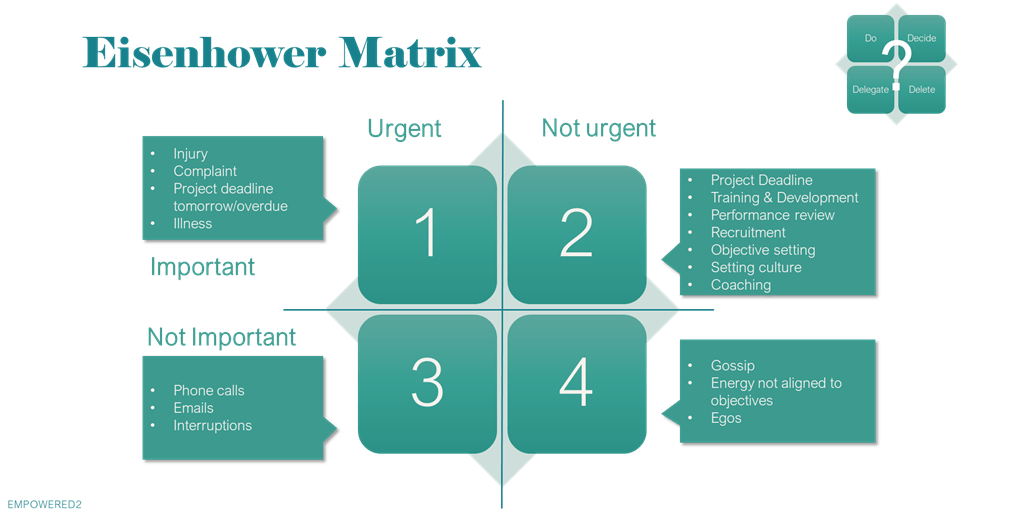
By splitting our tasks into these groupings we can gain clarity on where and how we are spending our time and importantly take action to correct.
We should be spending 80% of our time in the important, non-urgent box. Making progress on the big items and actions that make the biggest difference. The remaining 20% of our time can go to important urgent actions. By working in this way we are better colleagues, leaders and partners for our clients because working on the important things mean we hit our deadlines, be they internal or external, leaving some time for the unexpected or uncontrollable but always in control.
By contrast, working in the ‘urgent and important’ quadrant for larger periods of time will lead to high cortisol, late or just-in-time deliverables, poorly delegated tasks with a lack of appropriate oversight and availability for problem solving and course correction and the potentially dangerous air of ‘frantic busyness’ which will make colleagues be put off contacting you as they don’t think you’ll have time for them. Looking with a well-being lens It potentially the route to too much stress that can lead to burnout costing the organisation money from lost downtime and impacting the lives of other staff and putting more strain on those left to deliver to our clients.
The unimportant boxes in Eisenhower are also worth reflecting on, these maybe tasks/projects/meetings that others ask us to do and get involved with which doesn’t support our important objectives, or they might be general distractions – emails, calls, interrupters at our desks, WhatsApp’s, Teams messages, Slack to name just a few. When these messages flash up and we let them take our attention it takes us about 8 mins to get back on task with what we are doing, potentially hours of lost time every day or week. It is even more challenging when they are tasks set by peers or senior leaders which interfere in more important deliverables. At this point it is essential to gain the support of others to prioritise what can be done in X time available rather than try and do everything and fail to deliver anything well. When we are doing the hard work in important, not urgent, putting ‘do not disturb on’ using a meeting room, putting your phone to silent etc are all valid tactics to allow you to focus and achieve more.
A simple summary of the 4 quadrants of Eisenhower is;
- Do first
- Schedule
- Delegate
- Don’t do/Delete
…a health warning on quadrant 1 though and ‘do first’, if you can’t or don’t compare this to objectives or you constantly prioritise the requests from others which really sit in quadrant 3 if they do not align to your objectives you might get stuck in the ‘do first’ quadrant.. This is likely to lead to you constantly pushing out ‘schedule’ to the future. A dangerous short-termist trap.
So – how would you reflect on how you spend your time today? By being more choiceful about how and where we put our energy we can move more to the important tasks that really make a difference to what we are trying to achieve. We can also see the importance of developing our expertise through learning and development, wider reading or attending appropriate conferences – all of which are important but don’t have the ‘flashing lights’ of urgency in the moment!
For more information please visit https://www.eisenhower.me/eisenhower-matrix/
In the next article in the series we’ll be looking at how we ‘deep clean’ our time.
Deep cleaning our time
In consultancy there are 3 simple truths, work needs to be won, work needs to be delivered, and people need to be led and managed, which includes staff wellbeing, development and training if organisations wish to retain people! So where does our own and the time of our staff go……?
In this 3rd article in the ‘busyness’ miniseries we are looking at how consultants spend their time and building on articles 1&2 on ‘Setting objectives’ and using the ‘Eisenhower matrix’ as a highly effective tools to help prioritise our time on those things that make the biggest difference to performance.
In this article we want to reflect on how and where we spend our time to best effect?
So let’s look at how you spend your day, week or month, as a snapshot in time…..
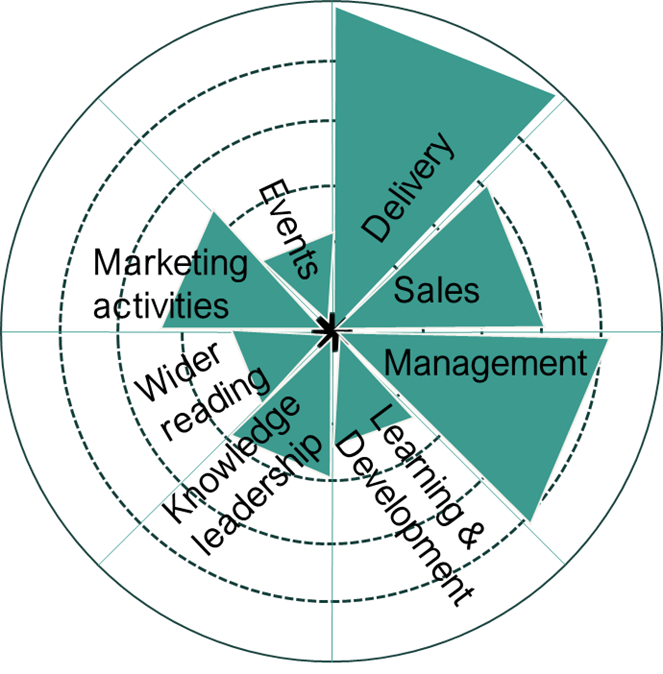
Allocating your time between delivery, business development, management and leadership and other activities like our own learning and development is a simple task which we should be able to do in <30 mins. We can tabulate this visually by assessing how much time we are spending into a radar diagram like the one in Figure 1 and the positive impact we are having on each of these elements, with a simple 1-5 score based on our perceived success on different activities relative to the amount of time we are spending on them. Whilst this is a subjective method, open to our own biases it is a good activity to help us think and reflect on how much time we should be spending in each area.
Undertaking this for yourself how does it look? Does it look wonky or smooth? Will it turn? Does it align to your objectives? Your role? Your job specification? What the business requires of you? Your seniority?
In our example below whilst delivery and management are being prioritised some of the ‘important’ activities across sales and business development, learning & development, contributing to knowledge leadership etc are all deprioritised. Whilst this consultant will be maximising their billable time they may not be creating future business or equipping themselves for future client challenges. Nor are they developing themselves for more senior leadership roles in the future or giving themselves talking points for wider client conversations. All missed opportunities. We know that creating sustainable pipelines of work is an essential part of consultancy to avoid the boom and bust of winning and delivering work and then having nothing when the delivery is done. The consultant or team that priorities delivery and turns off business development is creating a challenge for the future – if we can see this then we can address it.
It is also important to consider the time that might not fit into these buckets; communication with colleagues, travel time, procrastination on the best course of action for any given client or internal decision, office politics etc. Recognising the cost of this lost time and what can be done about it for example; better communication, clarity on strategy, culture improvements, celebrating exemplar behaviours, high performance tools etc can be very useful. A critical review of the ‘barriers’ getting in the way of organisational performance and effective use of time is a great activity for leaders to undertake and to ‘hear’ directly from staff at all levels on a regular basis.
So, be ruthless, how are you spending your time today? Does it align to your role and the objectives we covered above. How about the time of your team? Use the Eisenhower matrix to ensure you are spending time on the important activities that make the biggest impact.
Tools to support high performance
Lets consider a normal day…….Sam logs on at 8:30, they are excited about getting their teeth into a new project that just kicked-off. Before they get going they check their emails, with the normal company emails, market insights and messages on other projects from colleagues which they skim read to look at properly later there is also an urgent client email. Sam spends 30 mins responding even though the project is closed and the client hasn’t signed-off on the additional work packages yet. Actions complete Sam refocuses on the new project, then Teams pings and Jo wants to chat through the technical delivery they are doing. Jo is one of Sam’s direct reports and needs help now so….
It’s now 10am and Sam hasn’t made any progress yet….and so on….
Ever wondered if the software, systems and processes we have are helping or hindering our activity? When we need to focus how good are we at turning off notifications? Staying out of our inboxes? Not going down rabbit holes of other tasks our brains pop into our head when we are focused on a specific activity? All of these are killers of our time and focus and place roadblocks in our performance every day and yet they give us dopamine hits from being wanted, important and useful to our colleagues and customers, we feel important.
Ensuring these systems and processes are working for you, that you are not working for them is essential to high performance and making best use of your finite time.
Have you ever considered;
- Turning off the notifications for new emails and Teams messages?
- Only checking your emails at certain times of the day? E.g. 8am, 1pm and 4pm? And even setting an out-of-office message to let people know that is what you do?
- Setting ‘surgery’ or ‘contactable’ hours in your diary to let colleagues know they are free to contact you at certain times of the day/week?
- Coaching colleagues to empower them to make day-to-day decisions, within boundaries, without needing to check-in with you?
- Asked colleagues that when they come to you with a question that they’ve already considered the following X things?
- Asking colleagues to batch-up questions they might have and save them for a weekly 1-2-1 or contact you once a day, or in a 15 min stand-up meeting, not every time they have a question?
- Not logging into your emails at all on a given day to focus on a piece of work?
- Putting your out-of-office on for a whole day and told your team you were out to allow you to focus on something important?
- Taking a colleague on a walking meeting so you could talk to them without distraction? Or even taking a meeting whilst walking yourself so you could not be distracted?
All these techniques I have seen deployed by people I’ve worked with, trained and coached. The tools which work best depend on you, your team, their level of capability and the type of work you undertake, there is no ‘one size fits all’ answer. But what I have seen is that all the people who have applied these and other techniques have had a serious commitment to their own and their teams’ performance and their productivity has gone up and their stress levels have gone down! These techniques also free our time up for more important activities which we covered in the first 3 articles in this series which whilst not ‘urgent’ are essential for our ongoing development, market understanding and client relevance.
So, try one, if you are feeling overwhelmed, like there is not enough time in the day, week or month for all you need to achieve then one tiny change could be all you need to release the ‘pressure valve’ and allow you to create a positive feedback loop from which the 2nd-X actions are easier!
You can do it!
 EMPOWERED2